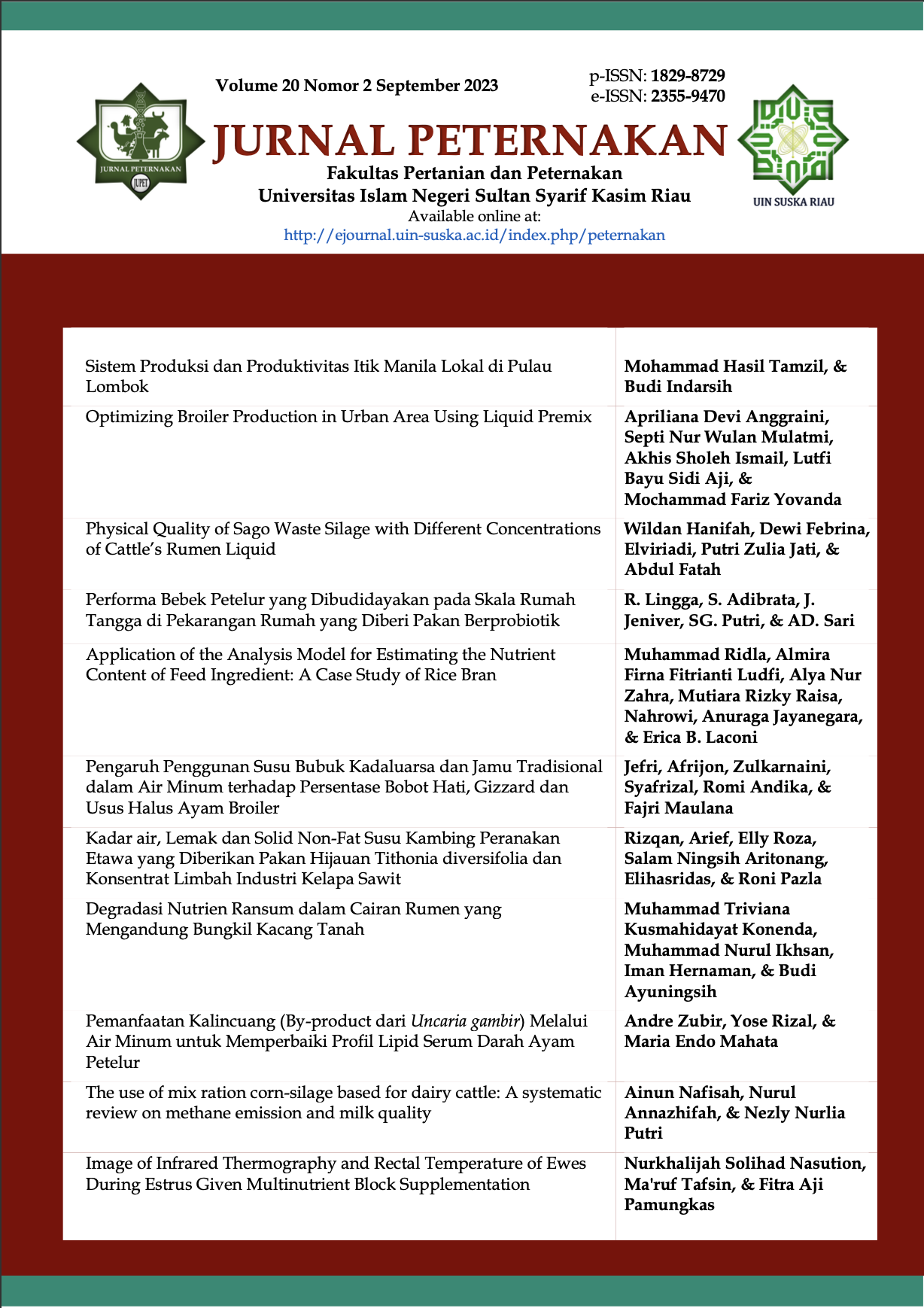
Application of the Analysis Model for Estimating the Nutrient Content of Feed Ingredient: A Case Study of Rice Bran
DOI:
https://doi.org/10.24014/jupet.v20i2.22692Keywords:
Density, correlation, crude fiber, crude protein, estimationAbstract
In rural areas, farmers face a significant challenge due to the lack of access to chemical analysis for feed ingredients. Therefore, there is a need for a new approximate analysis model that is lightweight and easy to apply. This study aimed to address this issue by utilizing bulk and tapped density analysis to estimate the composition of rice bran samples collected from 30 rural rice mill factories across 3 districts in Indonesia. The study used a correlation formula between bulk density values and tapped density values to estimate the crude protein and crude fiber contents of the samples. The study's results revealed significant variations (p<0.05) in the quality of rice bran due to various factors. Crude protein content significantly differed (p<0.05) across districts, with Bogor and Bandung having the highest values and Cirebon the lowest. Tapped density measurements generally yielded higher crude protein content values. Similarly, there were variations (p<0.05) in crude fiber content across districts and locations, with Cirebon having the highest values and Bogor the lowest. Tapped density measurements generally resulted in higher crude fiber content values, but there were significant variations observed in different districts and locations. The rice bran from the Bogor region showed indications of being of higher quality, with higher crude protein and lower crude fiber content compared to the other two regions.
References
Akbarillah, T., Hidayat, & T. Khoiriyah. 2007. Kualitas dedak dari berbagai varietas padi di Bengkulu Utara. Jurnal Sains Peternakan Indonesia. 2: 36-41. Https://doi.org/10.31186/jspi.id.2.1.36-41.
Astawan, M. & A. E. Febrinda. 2010. Potensi dedak dan bekatul beras sebagai ingredient pangan dan produk pangan fungsional. Jurnal Ilmu Pangan. 19: 14-21. Https://doi.org/10.33964/jp.v19i1.104.
Budijanto, S. & A. B. Sitanggang. 2011. Produktivitas dan proses penggilingan padi terkait dengan pengendalian faktor mutu berasnya. Jurnal Ilmu Pangan. 20: 141-152. Https://doi.org/10.33964/jp.v20i2.33.
Hamalinda, A. J. & I. M. A. Sudarma. 2022. Uji Kualitas Fisik dan Kimiawi Dedak Padi Penggilingan di Kecamatan Katala Hamu Lingu Kabupaten Sumba Timur. Jurnal Peternakan Sabana. 1: 91-95. Https://doi.org/10.58300/jps.v1i2.269.
Hasbullah, R. & A. R. Dewi. 2009. Study on effect of rice milling machine configuration on milling yield and losses of several paddy varieties. Jurnal Keteknikan Pertanian. 23: 119-124. Https://doi.org/10.19028/jtep.23.2.119-124.
Ilias, N. N., N. H. Mohd Rozalli, N. H. T. Vy, & H. Y. Eng. 2020. Rice Bran of Different Rice Varieties in Malaysia: Analysis of Proximate Compositions, Antioxidative Properties and Fatty Acid Profile for Data Compilation. Advances in Agricultural and Food Research Journal, 1: 1-17. Https://doi.org/10.36877/aafrj.a000016.
Kalpanadevi, C., V. Singh, & R. Subramanian. 2018. Influence of milling on the nutritional composition of bran from different rice varieties. Journal Food Science Technology. 55: 2259–2269. Https://doi.org/10.1007/s13197-018-3143-9.
Lavanya, M. N., N. Venkatachalapathy, & A. Manickavasagan. 2017. Physicochemical Characteristics of Rice Bran. In: Manickavasagan, A., Santhakumar, C., Venkatachalapathy, N. (eds) Brown Rice. Springer, Cham. pp. 79-90. https://doi.org/10.1007/978-3-319-59011-0_5.
Ling, B., X. Liu, L. Zhang & S. Wang. 2018. Effects of temperature, moisture, and metal salt content on dielectric properties of rice bran associated with radio frequency heating. Scientific Reports. 8: 1–12. https://doi.org/10.1038/s41598-018-22567-4
Marbun, F. G. I., R. Wiradimadja & I. Hernaman. 2018. The effect of storage time on the physical characteristics of rice bran. Jurnal Ilmiah Peternakan Terpadu. 6: 163-166. http://dx.doi.org/10.23960/jipt.v6i3.p163-166.
McDonald P, R. A. Edwards, J. F. D. Greenhalg, & C. A. Morgan. 1995. Animal Nutrition 5th Ed. John Wiley and Sons Inc. New York (US).
Nugroho, M., L. Liman, R. Sutrisna, & M. Muhtarudin. 2022. Uji Kualitas Dedak Padi di Kabupaten Lampung Tengah. Jurnal Riset dan Inovasi Peternakan (Journal of Research And Innovation of Animals). 6: 286-292. Https://doi.org/10.23960/Jrip.2022.6.3.286-292
Patiwiri, A. W. 2006. Teknologi Penggilingan Padi. PT Gramedia Pustaka Utama. Jakarta.
Ridla, M., R. S. H. Martin, Nahrowi, N. S. Alhasanah, & M. S. Fadhilah. 2022. Physical properties evaluation of rice bran forgery with corn cob addition. Jurnal Ilmu Peternakan Terapan. 6: 9- 17. Https://doi.org/10.25047/jipt.v6i1.3203.
Ridla, M., R. H. N. Adjie, S. Ansor, A. Jayanegara, & R. S. H. Martin. 2023a. Korelasi Sifat Fisik dan Kandungan Nutrien Dedak Padi. Jurnal Peternakan. 20: 1-8. Https://ejournal.uin-suska.ac.id/index.php/peternakan/article/view/18374
Ridla. M., M. R. B. Sabaleku, & Nahrowi. 2023b. Impact of using hermetic packaging and preservatives on physical properties of rice bran during storage. Buletin Peternakan, 47: 22-29. Https://doi.org/10.21059/buletinpeternak.v47i1.76880.
Sairam, S., A. G. G. Krishna, & A. Urooj. 2011. Physico-chemical characteristics of defatted rice bran and its utilization in a bakery product. Journal Food Science Technology. 48: 478–483. Https://doi.org/10.1007/s13197-011-0262-y.
Sartika, N. D. & Z. Ramdhani. 2018. Kajian penggunaan mesin penggiling mobile terhadap mutu beras untuk beberapa varietas padi di kabupaten sumbawa barat (study on mobile milling machine utilization in rice quality of several paddy variety at sumbawa barat regency). Jurnal Ilmiah Rekayasa Pertanian dan Biosystem. 6: 53–59. Https://doi.org/10.29303/jrpb.v6i1.72.
Saunders, R. M. 1985. Rice bran: Composition and potential food uses. Food Reviews International. 1: 465–495. Https://doi.org/10.1080/87559128509540780.
Downloads
Published
Issue
Section
License
The Authors submitting a manuscript do so on the understanding that if accepted for publication, copyright of the article shall be assigned to Jurnal Peternakan and published by Fakultas Pertanian dan Peternakan Universitas Islam Negeri Sultan Syarif Kasim Riau as publisher of the journal.
Authors who publish with this journal agree to the following terms:
Authors automatically transfer the copyright to the journal and grant the journal right of first publication with the work simultaneously licensed under a Creative Commons (CC BY) that allows others to share the work with an acknowledgement of the work's authorship and initial publication in this journal.
Authors are able to enter into separate permission for non-exclusive distribution of the journal's published version of the work (e.g., post it to an institutional repository or publish it in a book), with an acknowledgement of its initial publication in this journal.
Authors are permitted and encouraged to post their work online (e.g., in institutional repositories or on their website) prior to and during the submission process, as it can lead to productive exchanges, as well as earlier and greater citation of published work (See The Effect of Open Access).
